VEED Lipsync — AI Video Lip Sync Model
What is VEED Lipsync?
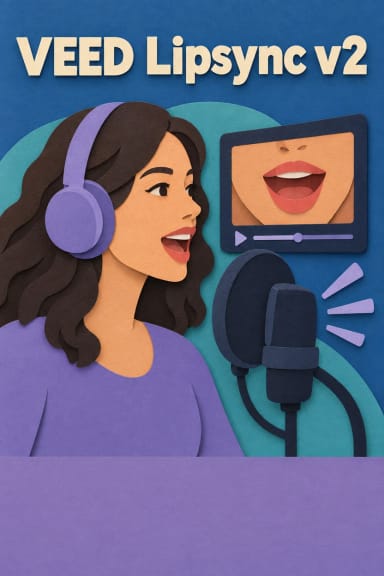
VEED Lipsync is a video-to-video model that re-syncs the lips of any talking-head video to a new speech audio track. Given a source video and an audio clip, it analyzes the on-screen face, then regenerates the mouth shapes and speech timing so the person appears to naturally speak the new audio — no manual keyframing, rotoscoping, or frame-by-frame animation required. Built by VEED and served through fal.ai, it is designed for realistic, production-grade lip synchronization across any aspect ratio.
The model works with existing footage, AI-generated avatars, and stock clips alike. Because it accepts any audio input, it slots directly into text-to-speech and dubbing pipelines: generate a voice track in a new language or with new dialogue, feed it alongside the original video, and get back a clean MP4 with matched lip motion.
Key Features
- •Audio-driven lip resync onto any face in a source video, preserving the original identity and background.
- •Format flexibility: video inputs in MP4, MOV, WebM, M4V, and GIF; audio in MP3, OGG, WAV, M4A, and AAC.
- •Any aspect ratio — vertical, square, or widescreen all supported.
- •TTS-compatible: works seamlessly with synthetic voice tracks for dubbing and localization.
- •Simple two-input API: just
video_urlandaudio_url.
Best Use Cases
- •Dubbing and localization — swap the audio for a translated voice track and re-sync lips for natural-looking localized content.
- •Video rephrasing — change what a speaker says without re-shooting the scene.
- •AI avatars and UGC ads — drive synthetic presenters or influencers with fresh scripts.
- •Course and training content — update narration while keeping the on-camera talent.
Front-facing subjects with a clearly visible, well-lit face and minimal head movement produce the most convincing results.
Prompt Tips and Output Quality
VEED Lipsync has no text prompt — output quality is governed entirely by your two inputs. Use clean, high-quality speech audio with minimal background noise for the tightest sync. Choose source video where the face is unobstructed, sharp, and centered; heavy motion, occlusions, or profile angles reduce accuracy. Match the audio duration to the video length so the whole clip is covered. Expect roughly 2 to 2.5 minutes of processing per minute of input video.